
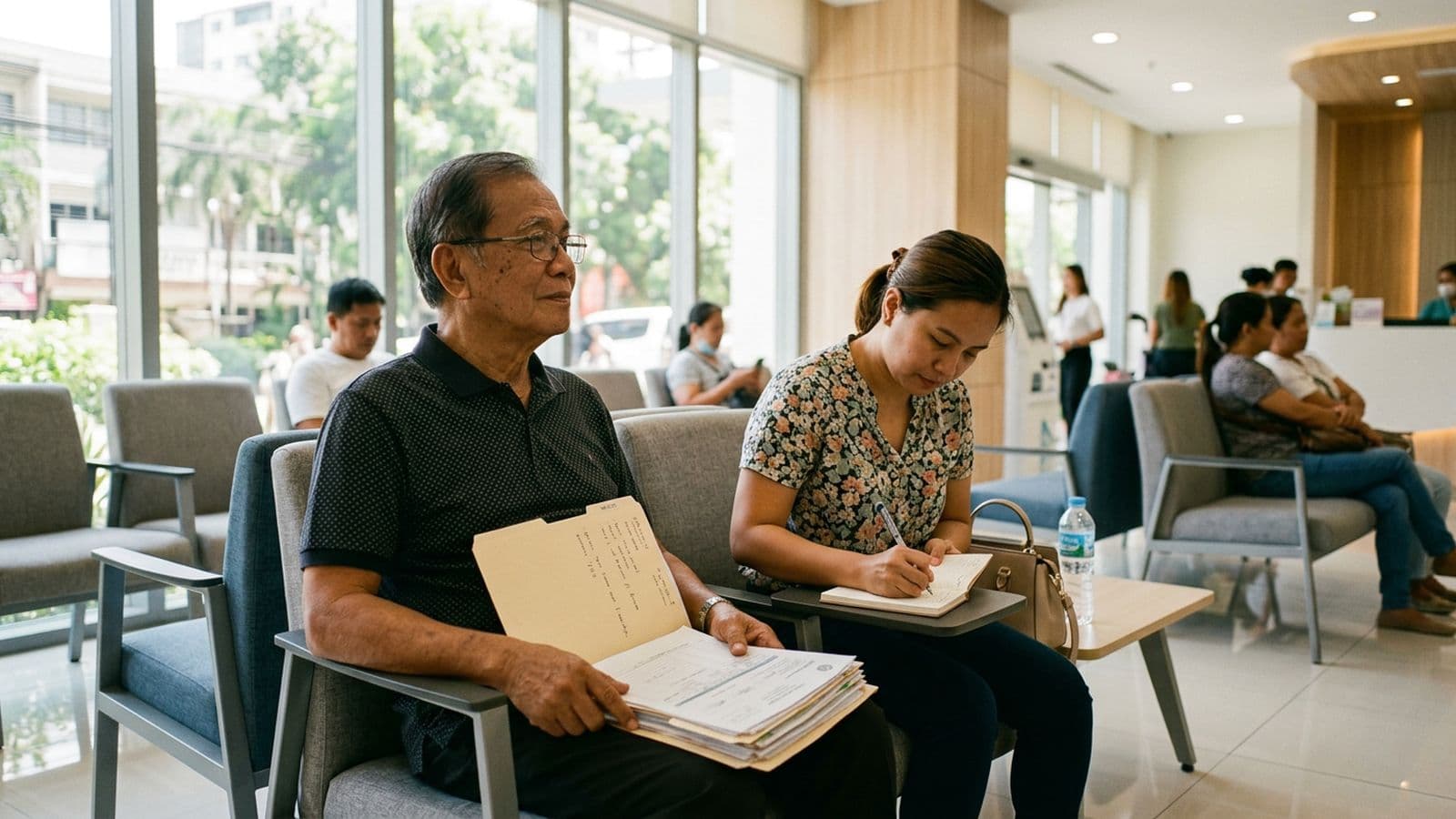
A checkup in a Philippine hospital is rarely twenty minutes. It is a queue, then a different queue, then lab, then a wait for results, then the doctor. Doing that alone at 70 is hard. Doing it while your children are in Singapore is harder. Here is who can go instead, and what they are allowed to do.
A Hospital Buddy is company, not a nurse
This is the whole boundary, and it is worth being exact about, because families often ask for more than the service can give.
What a Hospital Buddy can do: meet your parent in the hospital lobby, queue on their behalf where the hospital allows it, carry the folder of results and receipts, help find the right floor, sit with them through the wait, write down what the doctor said, remind them of the questions they meant to ask, help with the pharmacy run afterwards, and stay until they are in a taxi home.
What a Hospital Buddy cannot do: anything clinical. No medication, no injections, no blood sugar checks, no dressing changes, no help with dressing or the bathroom, no lifting or transferring. They do not speak to the doctor as a decision maker and they do not sign anything. If your parent needs any of that, hire a licensed caregiver or a nurse.
The lobby is a public place, the ward is not
Phriend meetups happen in public places, and a hospital lobby is named in the safety rules as one. The waiting area, the pharmacy, the cafeteria: all fine. What a Phriend is not there for is a private room, or a visit to the house afterwards, which is banned outright.
Whether a companion can go into the consultation itself is the hospital's rule and your parent's choice, not Phriend's. Many hospitals allow one companion. Ask when you book the appointment.
Consent is your parent's to give
Two consents matter here, and neither one is yours.
The first is whether your parent wants a stranger there at all. Ask before you book, show them the profile, and accept a no.
The second is medical information. If you want the Phriend to message you what the doctor said, your parent has to agree to that, in the chat, with both of them there. Health information belongs to the patient. A companion who relays it without being asked is overstepping, and you should not ask them to.
How to book one from abroad
- Verify your ID once in the app.
- Filter to your parent's city and the Hospital Buddy activity. Read the profiles for languages, availability and reviews.
- Message first. Say the hospital, the department, the appointment time, how long you expect it to run, that the meetup is with your parent rather than you, and anything the Phriend should know: that your mother is hard of hearing, that she prefers Bisaya, that she cannot stand for long.
- Agree in the chat who is coming. Only the people agreed in the chat come along.
- Send the booking request with the date, the start time, the hours, and the lobby as the meeting place.
Book more hours than the appointment slot. A 9am checkup is rarely finished by 10.
What it costs, and how it is paid
Hospital company usually runs ₱250 to ₱500 per hour, set by the Phriend, with no commission taken. Longer bookings are common, because the waits are long.
Payment is cash in person. The Phriend picks what they ask for at the start, nothing or 25% or 50%, and the rest is cash when it ends. Nothing is ever sent before a first meetup. If you are abroad, arrange with your parent or a relative who will physically hand it over, and do it in the chat before the day.
Money for the consultation, the labs and the medicines is a separate matter and should stay with your parent or go through you. Do not hand a Phriend a float for hospital bills on a first booking.
If something goes wrong
If the Phriend does not arrive, mark the no-show in the booking. If anything about the meetup felt wrong, report the profile from the app. Every member is ID-verified, and a person reviews each Phriend profile before it goes live, so a report leads somewhere.
If you want company at your own appointment rather than a parent's, read what a nonmedical companion can help with instead.